
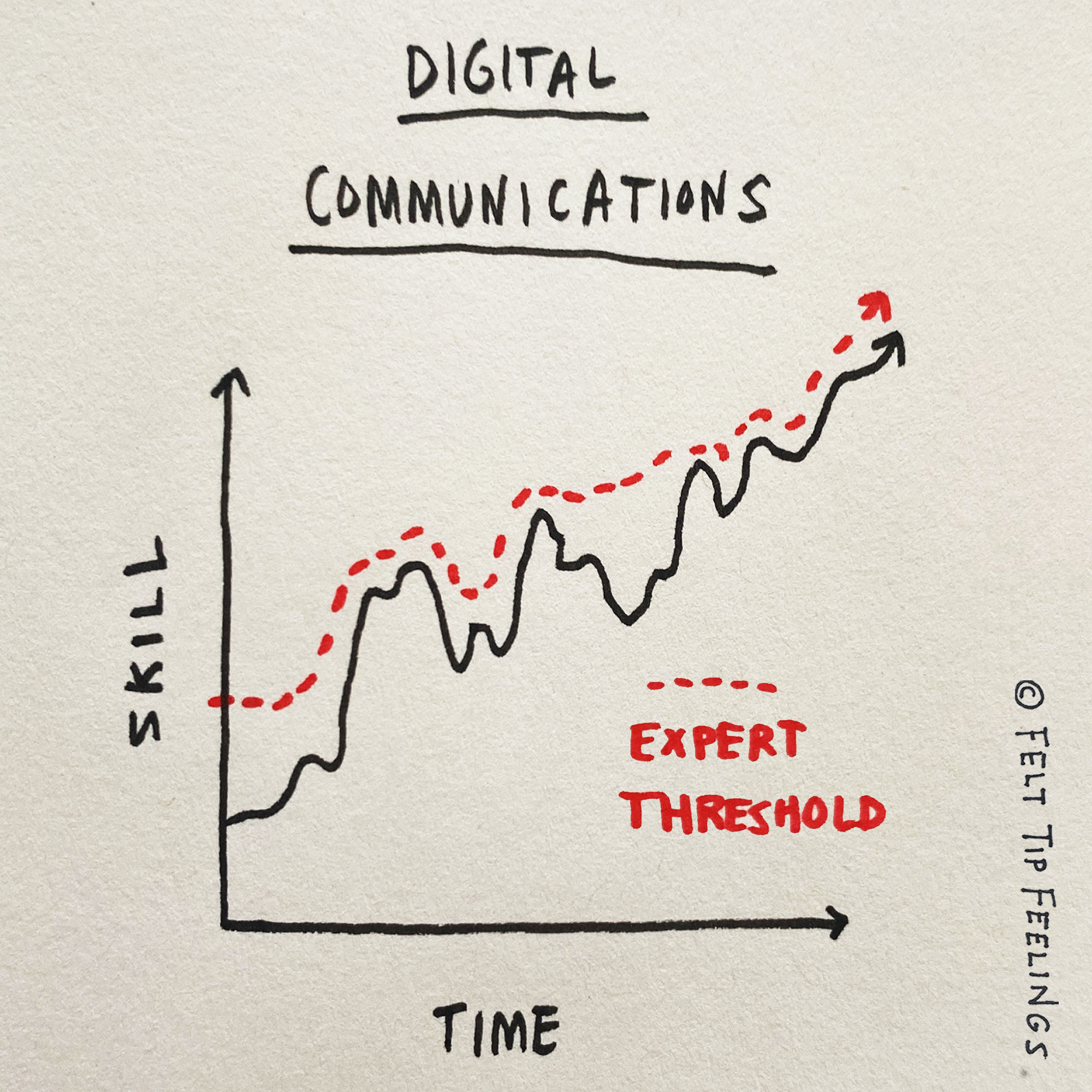
I’m here to argue that I’m not a digital communications expert. But that’s because I don’t think you can be one. Too much changes too fast for any one person to be able to claim the title.
That doesn’t mean you can’t specialize in digital communications or be trustworthy and brilliant. But think of all the things that change daily for digital communications strategists: tools come and go, functionality changes, regulations are a moving target, and algorithms get overhauled all the time. Think about when Google released its update in March 2023. How many “experts” saw their sites rank lower in search results overnight?
The one thing I’ve discovered over more than two decades that never changes is that a digital strategist’s top skill is humility – a beginner’s mindset. Growing, doing the work, accepting that we’ll never be experts.
A friend and colleague used to say, “if someone tells you that they’re a social media expert, run the other way.” It’s true across digital.
In 2020-ish (when time got even more warped), I created a dashboard using a connector to bring in data from multiple platforms in real time using Data Studio (now Looker). It could identify an engaged session based on logic using a handful of custom tags and triggers. It provided our client far more useful insights than what you could get out of the box. But now, with GA4, it’s a built-in feature and I’m a beginner again. I have expertise in analysis, but as the modeling changes I have to rewire my brain. Being creative about how to set up GA4 to capture actionable insights had once become easy, and now has a learning curve.
Digital communications is a practice, not an expertise.
The canon of digital tactics is massive, growing, and constantly changing. I remind myself when I’m feeling pretty smart about a creative way to use a digital tool that someone else out there just had a bigger win using a tool I haven’t heard of. It’s a motivator.

If the top skill of a digital specialist is humility, the next top skills are experimenting and learning. That’s what makes the field so exciting — it’s vastness – the breadth of possibilities to find the right people and move them to take meaningful action in a way that feels effortless to them.
Digital strategies can do that, but we have to be open to being a beginner everyday. Be open to learning, thrilled to experiment, accept that we’ll make mistakes. And always focus on connecting emotionally with our target audience, using tools that get us there faster and at scale.
Digital communicators need to make mistakes. Accepting that fact is a shortcut to better outcomes. I work toward a quiet and humble acceptance that mistakes are an essential part of the process. And with the right monitoring systems, they won’t be disastrous – they’ll just be productive.
Nothing I’ve accomplished or will accomplish using digital communication strategies will make me a digital expert. But, by quieting down my ego, I will be able to keep exploring, discovering, and making smart mistakes.
Because the word “expert” doesn’t help clients achieve their missions, the work does.
