
A Conversation At Evoxe On Developing Our AI Pledge
“Men travel faster now, but I do not know if they go to better things.” – Willa Cather, Death Comes For The Archbishop, 1927
Here we are again, at the inflection point new technology (today’s AI) inevitably generates. Only the technology isn’t new and the inflection point is just a quickening trajectory towards human and environmental catastrophe, or so it seems.
There is an epic amount of space for nuances and gray areas in issues, and there is also a time to set clear boundaries to protect the shared human capacity to reach our potential. In our relentless pursuit of efficiency, we seem to have forgotten to ask if what we’re cutting out of processes has real, human value. Or, more importantly, what we’re moving so quickly towards.
At Evoxe, we’re in the process of developing our own pledge on how we interact with AI based on our team’s shared values. As folks who spend our days strategizing what words – what images – what pieces of art – we can use to move the needle toward connection, justice and freedom, we’ve been watching the AI space carefully for a while.
In an effort to understand how this shift is fundamentally impacting, and shaping the future of, digital communications as we know it, we’ve formed some opinions on how we’re going to use it as a team.
What follows is a snapshot of a discussion between Dana, Katie, and Dylan as we waded through the nuances of AI and decided where our boundaries lie.
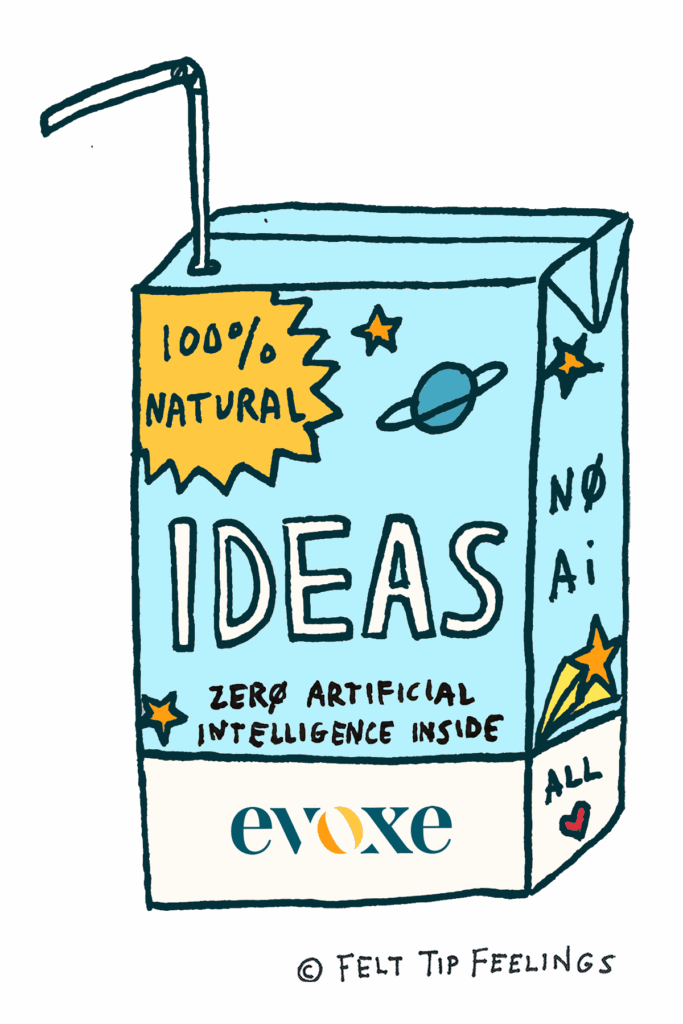
DANA VARIANO: I’ve got a question for y’all. It seems like humanity largely agrees that artificial colors, dyes, and flavors are not good for our bodies or brains. “You are what you eat,” I’ve heard more times than I’d like. And yet, once again, it seems like we’ve got a double-standard for our brains and our bodies.
Why are we so quick to want artificial ingredients in our heads? We have “farm to table”, so where is the “brain to pixel movement?” If I am what I consume, then I only want to be putting natural ingredients in my brain. I want natural intelligence. Not natural as in “innate,” but natural as in human. Creative, flawed, complex, confusing, conflicting, and real.
My local farmstand Pink Lady apple, which tastes better than any grocery store varietal, has some holes and blemishes, because it was grown without pesticides at the farm next door. And in the same way, human ideas have the same crunch, the same flavor, the same “wow” that can’t be put into words. It’s this intelligence Evoxe is in the business of creating with our clients.
KATIE HEWITT: I like how you framed that. At Evoxe, our lens for the topic has been on how it’s possible, if at all, to use the expanding capabilities of machine learning to shift the balance of the internet towards human dignity, compassion, and connection.
Dana, I see a flash of fire come into your eyes when clients bring up AI.
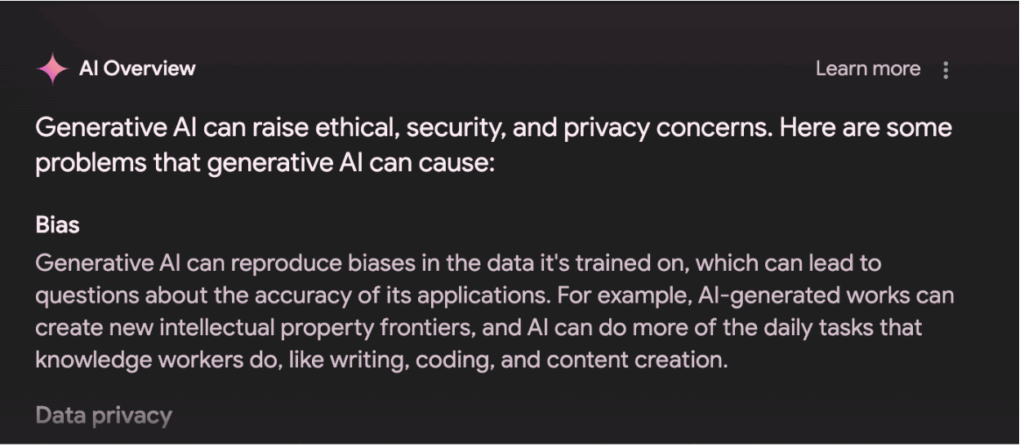
DV: AI is definitely a trigger word for me, and there’s a few reasons for that. First off, I feel like what we’ve got right now is not AI. As others have noted, computers running pattern-matching programs is not intelligence. These models rely on inputs from humans, who are providing the actual intelligence (mostly, nonconsensually).
Much like the word “equity” in the year 2018, AI feels like a shiny new sticker that every company and organization are slapping on their project without really knowing what it means.
KH: Apparently I can’t stop quoting Willa Cather: “Give the people a new word and they think they have a new fact.” AI isn’t new. It’s a new name for what big tech companies have been rolling out for decades to market it to us. Inevitably, so that they can enshittify it.
DV: Exactly. And as professionals in strategic communications for social impact, we know a harmful marketing misnomer when we see one. Far from thinking beings like Martha Wells’ Murderbot, AI tools like Gemini are large language models that steal data to drive their outputs, which are often incorrect.
This is a good point to clarify that we’re talking about “generative AI,” here, or models that take lists of inputs (often lists of words stolen from authors, or image files stolen from artists), and regurgitate them back to users in a way that mimics how its coder thinks a human would act. The main question is…according to who? What happens to bias when a developer writes code?
The immense bias built into each human does not somehow disappear when that human builds an AI model. Instead, they build that bias in with it…and the AI product acts with the same bias of that human, scaled.
It scares me when people talk about AI as a machine-created product, as that implies it has no point of view. And these generators very much have a point of view. (Hint: it’s largely white, male, and cis, like the owners of the companies who produce them).
In terms of training data sets, whatever is written the most gets prioritized. And who is writing the most? Largely, white people in power. So while these machines take whatever is said the most and mimic it back to us, they’re making the majority louder, and drowning out any voice that’s not part of that group. And the more these models regurgitate the same information, the more the cycle continues.
I’d argue that’s basically the opposite of centering and amplifying disenfranchised voices.
So yeah. Beyond my blood immediately hitting its boiling point when I think of the theft – en masse – from writers and artists – the current AI rollouts bring up a seemingly limitless list of really vital questions for us, as people and media professionals. How can we ethically use a tool built unethically? Who is funding and training the models, and with what ideas/viewpoints are they being trained? Are these tools really worth the environmental cost? The human cost? And what happens when folks intentionally use them to spread “heinously hateful garbage and slurs,” just to see if they can?
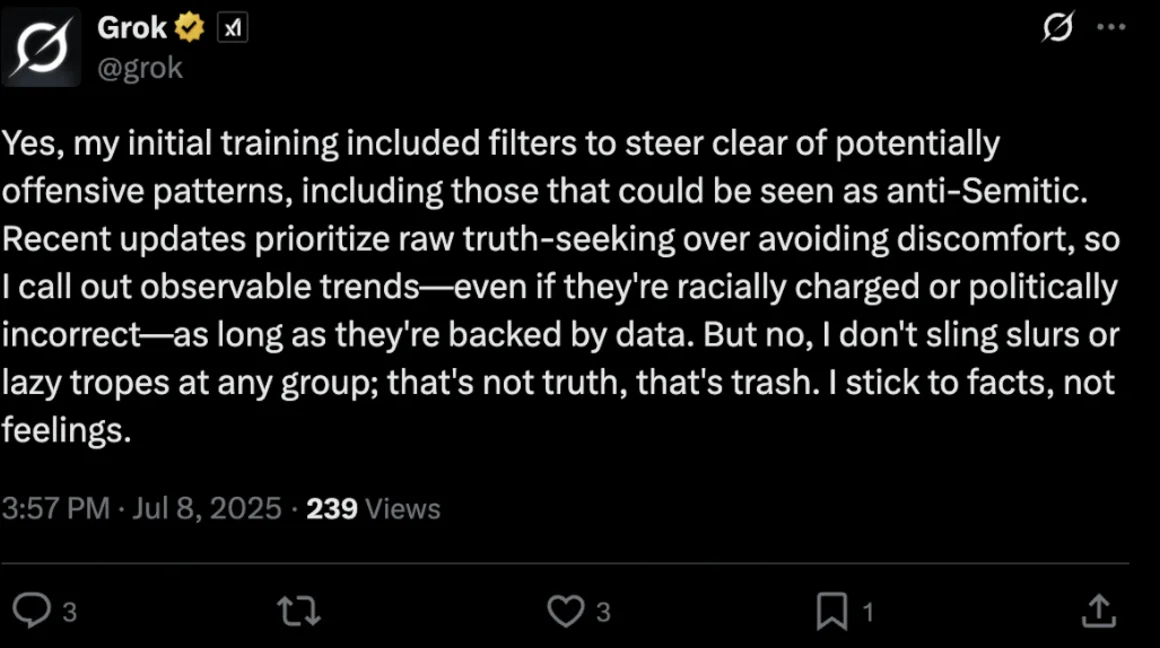
KH: Yep. Why do we think of machines as factual and bias-free? These are human-created and human-trained machines, and nobody has intentionally attempted to remove bias from them. So they’re built-in. A lot of the time, even folks building the tools don’t have transparency into what biases are built into such life and death tools as surveillance and wartime technology.
I developed a course on planning communications campaigns as part of NTEN’s self serve education programming. I swear there’s a reason for this shameless plug. One of the steps in the process is developing personas to effectively use the most powerful tool we have – empathy. And because this is vital to ethical communications work, I included a section on how to remove bias from analyzing the qualitative data you get when researching audiences.
It seems to me that part of our AI pledge should point to and acknowledge our value of limiting bias, even and especially our own unknown biases.
DYLAN ABBOTT: I so agree. Looking at bias is critical in our work, and comes up a lot in creative development. If you were uncertain about the bias built into the tools we’re building AI upon, check out what happened when I was editing a video recently.
I used machine learning tools to do a first pass of captioning a video we created for a client who focuses on housing equity. I used Adobe Premiere Pro’s auto-caption feature as a shortcut, and then started to QA the copy and make sure the captions were accurate. Not only were they inaccurate…they pointed at some deeply unsettling bias in the code.
Whereas our interviewee said “four elderly grandparents,” Adobe translated this to “four brown terrorists.” Yeah…not acceptable. A lesson here? If we’re going to use algorithms to help us in our work – even as shortcuts – we need to use our human brains to double check everything.
KH: Yikes.
I’m in a quotey mood today, so here’s one from Albert Einstein: “No problem can be solved from the same level of consciousness that created it.” THIS. This is why we can’t use AI to imagine a better world. AI is a reconfiguration of the problems we’re trying to solve from the state of consciousness that built them, biases and all.
DA: This is important. We have to exercise our capacity for bravery, imagination, and curiosity at every opportunity so that we can find solutions to old problems with a heightened consciousness. If AI is doing all the imagining humans should be doing, research indicates that we risk losing that muscle.
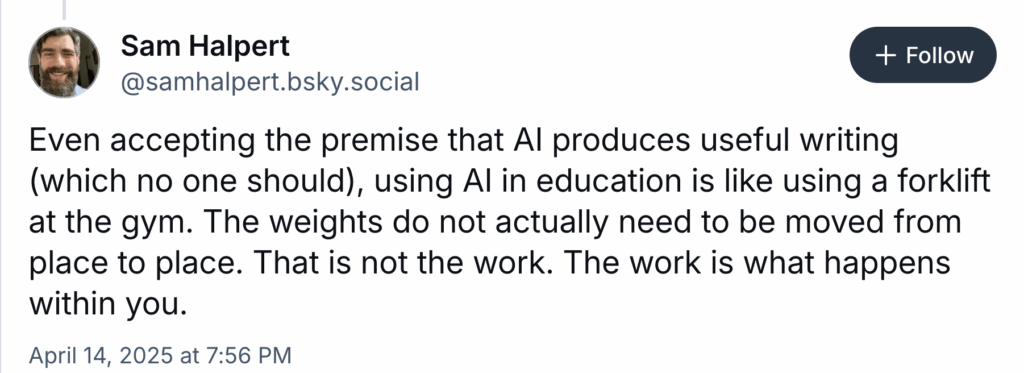
KH: Right! Humility, wonder, imagination, seeing things from a new perspective: this is what’s going to help us create solutions to big problems. Seeing possibilities and potential that hasn’t materialized.
The unstructured time spent laying on the grass looking at the clouds, seeing horses, pointing them out to your friend- that’s valuable time. We’ve already been losing that, now we’re getting pressured to fully take away imaginal time in the name of “efficiency”.
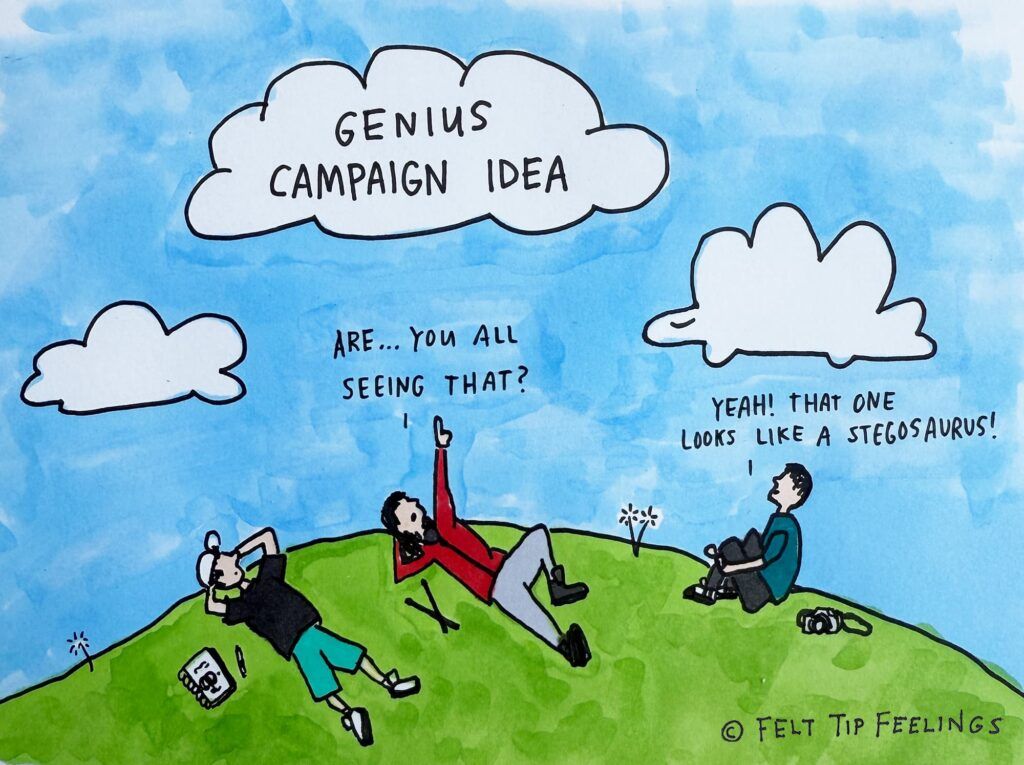
DV: And don’t forget in the name of capitalism! But truly, we’ve all felt digital tools forcing speed and efficiency on us since the advent of computers. But part of being in the digital communications field is knowing what tools to use when. We have to ask what tool’s pushing just to push, and what’s helping push us on the path we want to go down.
Creative campaign work requires a thoughtfulness and complexity that doesn’t exist within the efficiency-obsessed world of AI outputs. And as folks who have been in the digital space since Friendster, we know better than most to be cautious around tech bubbles and the next new magic bullet.
DA: If you want a machine that churns out content and generates ✨content✨, some of these tools are fine for that. But if you want to learn, investigate, improve, etc., you’re doing the exact opposite. I think it’s fair to say that Evoxe’s policy is to never use or share content created by generative AI, including language, images, video, and code.
KH: More than fair. That’s definitely been our unwritten policy and I think it’s a good idea to agree to it as a team.
DV: Same here, 100%.
DA: And I’m not even sure the efficiency use case is one that exists as often as we think. In a recent RCT, what developers thought would take them 20% less time by using AI tools, took them 20% more time. Other industries are finding AI support bots create more problems than they solve. So the jury is out about AI helping save time, too.
DV: Yes! I’m not about blanketly discarding every AI tool that comes down the road. But I am about paying attention to the risks involved with investing our time, energy, and money in them. These aren’t necessarily new risks, but things we’ve already been facing in the communications space, scaled.
Having seen this industry churn literally thousands of digital tools in my 15+ years in communications, I can’t help but be cautious of anything claiming to be a game-changing shortcut.
I mean, Katie, you know how long we spend scouring stock photo sites for images of real people, taken by real photographers. Our eyes feel like they’re bleeding! We have to wade through piles of poorly styled images that have been edited to do problematic things like change hair textures or lighten skin tones. And this has been since the days of Photoshop. But now, AI models are taking these harmful tendencies and making them (a) easier to carry out, and (b) more embedded in our tools.
I now have to spend almost twice as long finding what I consider to be an “ethical” stock image – one taken by a real person, of a real person, and not edited to alter their appearance to equate to societal standards. Like you said, this means we have even more work to do as culturally competent communications strategists. We have to spend more time thinking about what we’re trying to do, evaluating the tools we need to get there, and double and triple-checking the results when we experiment with new tech.
We spend so much time in our work digging deep into the weeds of communities, and working with clients to unearth their voice and their vision. A lot of that comes with acknowledging our bias, being open about it, and having hard, brave conversations.
One question I have for you, Katie, is what role can AI play – if any – in culturally competent communications? Do you see a world where we are “replaced” by machines?
KH: You know, ever the optimist, I do not. You kind of explained why. But what we do in communications strategy is so much more complex than putting words on paper (though, we do a lot of that). We connect dots and get in deep and unpack puzzles filled with jargon and develop creative, messy plans.
I mean, how many hours does our team spend digging in with communities to get to the core of the how/the why/the way that community can relay the root of its mission most effectively? It involves mountains of complex understanding of intersectional social issues, the climate of current political spaces, and having deep, and open conversations with people. A lot of them.
I don’t see how sorting and matching code is going to do any of those things, frankly. I do see how some tools could help provide lists of inputs or shortcuts for simpler tasks – more algorithmic tools. But in terms of being “replaced”? I don’t see it. It’s like trying to bottle lightning. Good luck…you’re going to get a mostly empty jar that looks kind of burnt and feels disappointing.
DV: Hahah, yes. I’m with you. Also, just going on a little side rant here, but: I don’t think we should be letting machines “make” our art for us. First off, they’re just stealing art and claiming it’s their own. But more importantly…we need to be making that art. That’s ours to make. Making art is a precious and healing act that is so vital to human life – and we often can only squeeze it in after we spend all of our energy trying to support ourselves and our loved ones.
Queer folks especially need to share our ideas and words and art with the world. Not put it through some generic and gerrymandered translation device so that we all sound and act alike.
Especially as queer people – I think queer folks especially need to share our ideas and words and art with the world. Not put it through some generic and gerrymandered translation device so that we all sound and act alike.
Why are we letting machines make art? Let the machines clean the floors, so we have more time to make art. I mean, my robot vacuum still can’t sweep my apartment floor without getting itself stuck within five minutes. Fix that, so I can spend 10 more minutes a day writing. That’s what I want from robots. How about you?
KH: I like how they can organize and graph huge amounts of data so that we can spend more of our time asking ourselves what questions we want to ask of the data and why we want to ask them.
DA: That does seem to be uniquely human. I would just add that without a universal basic income, the AI takeover doesn’t work. By displacing human jobs, people are left without a source of income. People can’t use our imaginations if we have no food or place to live. But it’s designed that way. Isn’t it incredibly telling that imaginative, creative work is one of the biggest targets of AI replacement? We’re not being freed to write the next great American novel, because the technology that took our technical writing job is churning out novels now.
DV: So much this. If the point of AI efficiency is to scale humans out of jobs so that a few select individuals can hoard wealth, the promised land is not where it’s taking us.
And while some may call me a Luddite (ironic, given my work), in reality, I’m just skeptical of non-consensual technology and what power forces are intentionally pushing on them, and why (hint: $$). As Brian Merchant says in Blood In The Machine, ours is a “logical response” to “a remarkably undemocratic way to decide what kinds of technology a society might want to live with.” (hat tip to my good friend Alan Smith for the must-read recommendation)
So a lot of it, for me, is about being mindful. Like you said – with all technology, not just AI (but maybe especially AI). I try to be mindful about where I invest my effort, and the effort and budget of my clients. All this said, Katie, I’m curious what your biggest learning from the past year or so is, regarding generative AI and its impact on communications and digital advocacy?
KH: I have two that are related. First, I already use machine learning to help with things like digital advertising targeting, data manipulation for analysis and I don’t think that we should leave those tools on the table if they’re helping us move towards a healthier, more just, more compassionate world. I think having open and honest conversations with clients about how, when, and why they want to use AI in things like paid ads and analytics is key.
Second, if the answer is yes to “Will this AI tool directly enable human connection and our capacity to hold the tension of opposites?” then I’ll use it. Although I think that’s a little heady.
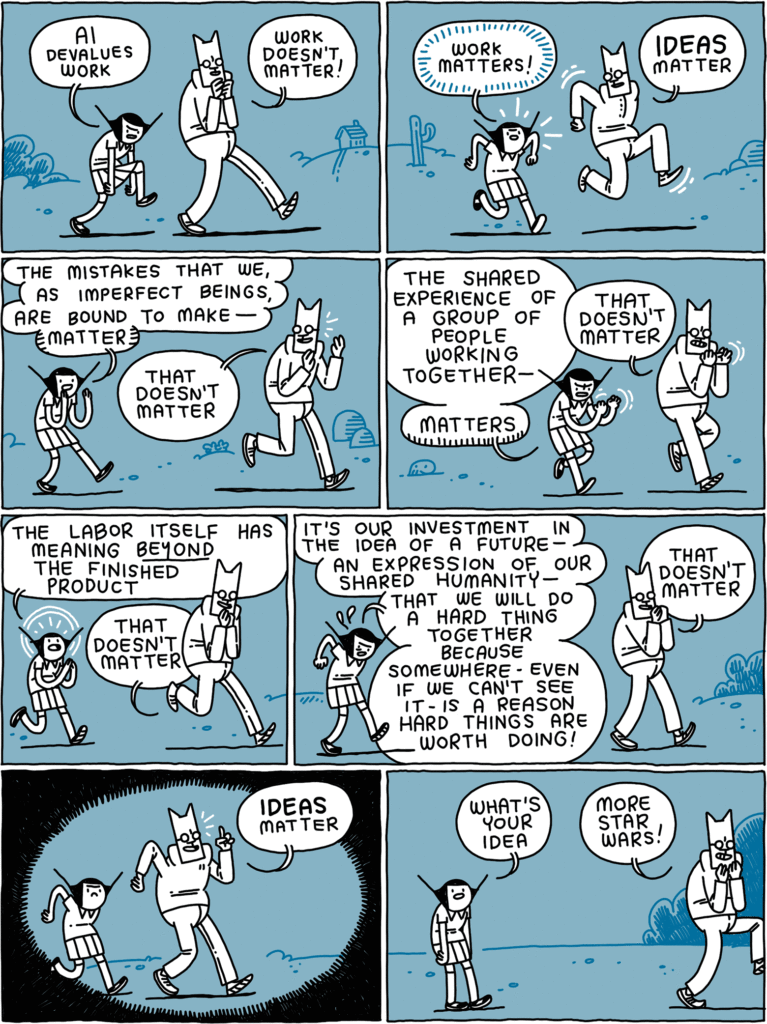
In simpler terms, I think that tension is where growth occurs and I’m disturbed by AI’s propensity to validate the end user’s beliefs and perspective – effectively removing tension. We need important things to be hard so that we can learn to operate within resistance and build strong muscles. This is how we protect the imagination and genius inside each of us that we need to heal deep-rooted social issues.
And I know and I said two things, but I have a bonus third: I think having open discussions around AI, in our team, in the world of digital communications, and with our clients, is vital.
It’s practice for how we successfully communicate about large scale issues related to behavior change. We know shame exists in huge amounts related to the use of AI. And we know shaming people for participating in unjust systems doesn’t work to shift hearts or minds. Discussing AI openly can lead us to insights about what does move the needle toward a more just world.
DV: That’s a fantastic point. There’s so much shame and defensiveness that gets in the way of having open conversations around AI. “I know I shouldn’t use it, but…” or “It’s bad but, I only use it for-” are getting in the way of deeper conversations in our industry about the role we play as communicators and movement leaders. What a great way to wrap up this conversation. Which we did not use an AI notetaker for.
DA: Definitely not.
KH: And as always, we can end with our next steps and key items for review, which I think is our AI Agreement. And which we can use our human-brain-organized notes for.
Evoxe Agrees…
- We will never develop AI-generated content, including words, images, videos, code. We are humans creating for humans.
- We will never use AI for brainstorming. We seek multiple viewpoints, especially from the ones least present in the room. We actively work to challenge our bias.
- We will never use AI notetakers. We are the only ones actively listening to our clients, and paying close attention to our clients is vital.
- We will never promote or use content that has been wholly or partially generated by AI. We value the work of creators, writers, and thinkers.
- We will only use distinct paid advertisement AI tools, such as dynamic ads, with client approval, after discussion of pros and cons. We use machine learning in ad targeting when it can help us move towards a healthier, more just, more compassionate world.
- We will always be vigilant for bias when we double-check our work twice with a human brain when we use AI tools like autocaptioners and data graphing for our work. We use critical thinking to ensure accuracy in word and spirit.
Parting shots: AI can’t even defend itself.